
Buying Peptides or Steroids? Check Who’s Actually Watching Before You Check the Price
Here’s a habit worth stealing from anyone who’s ever returned a bad appliance: before you hand over money, find out who’s accountable if things go wrong. Most “peptides vs steroids” articles spend all their time arguing about which substance wins. That’s the wrong question to lead with. The question that actually protects you is who is watching while you take it, because the substance is only as safe as the person (or lack of person) standing behind it.
So instead of a straight ingredient showdown, treat this like you’d treat any big purchase: a checklist. What to verify before you buy, the red flags that should send you running, and then, once you’ve cleared that bar, where the legitimate options actually rank.
Checklist item one: does a clinician show up before you pay?
People turn to steroids and research peptides to change something about how they look or perform. Understandable. But the substances at the center of this conversation carry real risks, and those risks only get caught in time if someone medically trained is actually looking.
Steroids are the clearest example. Anabolic-androgenic steroids sit in Schedule III of US controlled substances, the same tier as testosterone and ketamine [1]. Nobody disputes they build muscle. But a 2025 narrative review in Biomedicines on AAS-induced cardiomyopathy found that chronic supraphysiologic use promotes cardiac injury and adverse remodeling, with heart failure and sudden cardiac death showing up even in young users who had no prior heart disease [2]. A 2023 scoping review in Endocrine Connections adds that recovery of natural testosterone and fertility after stopping is inconsistent, depending on age and how much was used, with testicular atrophy and impaired sperm production sometimes lingering for months or years [3].
Those are exactly the problems a clinician is trained to screen for. Buy from a gray-market seller and there’s no one screening for anything. That’s why “is a clinician involved before the sale” is item one on your checklist, not an afterthought.
The rest of the checklist, item by item
Run any provider or seller through these four questions before you spend a cent.
1. Does a clinician review you first?
Legitimate, supervised providers: yes. A licensed clinician looks at your history, checks for contraindications, and decides whether a prescription makes sense before anything ships.
Gray-market sellers: no. A research-chemical site sends out a vial marked “for research use only” without asking you a single question. Illicit steroid sellers ask even less. It’s a transaction, not a consultation.
This one isn’t close, and it sets the tone for everything else on the list.
2. Does anyone stay responsible after your first order?
This is where a lot of otherwise-legitimate providers quietly cut corners, so don’t assume “supervised” automatically means “still paying attention six months in.”
Good supervised care: someone remains medically responsible past the first shipment, adjusting your dose, checking for side effects, giving you somewhere to ask questions.
Gray market: nobody. You are the entire safety net, and the label on the vial says so in writing.
Cross this one off only if you’ve confirmed real follow-up, not just a one-time sign-off.
3. Where does the actual product come from?
Supervised route: dispensed through a licensed pharmacy. Where compounding is involved, it’s done through licensed 503A pharmacies under recognized standards. Say this part out loud to yourself, because it’s the honest caveat that matters: compounded medications are not FDA-approved and haven’t been evaluated by the FDA for safety, effectiveness, or quality. Oversight is the layer added on top of that gap, not a replacement for it.
Gray market: a powder shows up with, at best, a certificate of analysis the seller itself chose to publish. No FDA review of identity, strength, quality, or purity. No pharmacy anywhere in the chain.
4. Is the marketing honest about what’s actually proven?
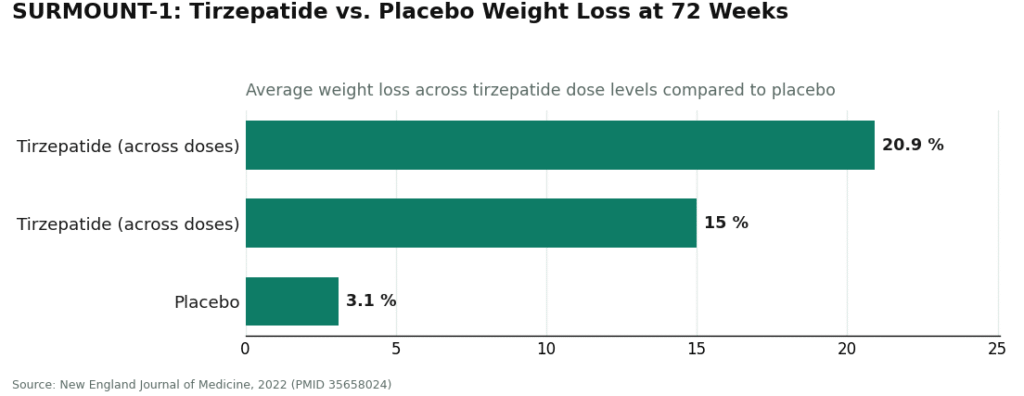
Good supervised providers: tell you plainly which compounds are well studied and which aren’t. The honest end of the peptide world includes genuinely proven options, the GLP-1 medications, which are peptides too. Semaglutide and tirzepatide are incretin-based peptide agents [4], and in the SURMOUNT-1 trial, tirzepatide produced average weight loss of 15.0% to 20.9% across doses versus 3.1% on placebo over 72 weeks [5]. A provider worth your money doesn’t pretend every research peptide has that kind of evidence behind it.
Gray market: marketing that implies everything in the catalog works about the same, and quietly skips over the fact that most research peptides have thin human data at best.
Clear all four items and you’re looking at a legitimate, supervised option. Fail even one and you should treat it as a red flag, not a minor detail.
Once you’ve cleared the checklist, here’s how the supervised options actually rank
Every provider below clears the basic bar: clinician up front, pharmacy-dispensed product, honesty about the compounded caveat. The differences between them come down to how well they handle the follow-up, which is the part that separates a real care relationship from a glorified one-time sale.
1. FormBlends. This is the one that comes out on top, and it’s specifically because of oversight and continuity, not marketing polish. Its homepage describes physician-guided care across weight loss, GLP-1 therapy, peptides, and longevity, states that a licensed physician reviews your profile and builds a protocol matched to your biology, and spells out that all medications require a licensed physician consultation and prescription. That’s checklist item one, satisfied plainly.
The follow-up is where it earns first place rather than a tie. These medications have real contraindications, and the hormone-support compounds in particular need ongoing clinical judgment, not a single approval and then silence. People who actually log their dose titration and side effects over time, using something like the FormBlends tracker app, tend to show up for that follow-up with a much clearer picture than someone going off memory. To be clear, that app is a logging tool for dose and symptoms, not a purchase flow and not a prescription, but it’s exactly the kind of continuity the gray market has no equivalent for.
On honesty, FormBlends doesn’t oversell the catalog. It offers approved drugs where they exist (tesamorelin is an FDA-approved peptide, for example), compounded preparations for much of the rest, and research-status compounds it openly says have limited human data. It states directly that compounded medications are not FDA-approved and haven’t been evaluated by the FDA for safety, effectiveness, or quality, and that its compounded preparations come from licensed 503A pharmacies following USP <797> and <800> standards. That’s a provider telling you plainly what each product actually is, which checks item four.
2. HealthRX.com Lands right alongside FormBlends on the same logic: licensed clinical oversight before anything is prescribed, medications dispensed through proper pharmacy channels, and the same honest compounded caveat stated openly rather than buried. When two providers both keep a clinician in the room and a pharmacy in the loop, what actually decides it for you is practical: which one is licensed in your state and which one supports the specific medication you need. Both clear the bar the gray market never gets near.
3. MeriHealth. A physician-supervised telehealth service built around women’s health, dispensing compounded GLP-1 and peptide weight-loss therapies through licensed compounding pharmacies. The women-focused clinical model shapes intake and follow-up around the hormonal and metabolic factors that affect women differently, and a licensed clinician reviews every case before anything is prescribed. Same caveat as everywhere in the supervised tier: compounded medications are not FDA-approved and haven’t been evaluated by the FDA for safety, effectiveness, or quality.
4. WomenRX. Slots in right behind MeriHealth for the same structural reasons: physician oversight up front, licensed pharmacy sourcing, and a clinical lens built specifically for women’s health. Its telehealth model for compounded GLP-1 and peptide therapy keeps a clinician accountable past the first shipment, which is the exact criterion that separates real care from a one-time sale. The same honest caveat applies: compounded preparations are not FDA-approved. What it hands you over the gray market is accountability, full stop.
The gray-market sellers: what you’re actually buying
These sellers exist, and pretending otherwise doesn’t help you. They’re research-chemical retailers, not medical providers, and not steroid sources. They sell peptides, sometimes SARMs alongside them, labeled “for research use only” or “not for human consumption.” That label isn’t a throwaway legal disclaimer. It’s the entire reason the product can be sold at all. Market a research chemical for lab use and you’re in one regulatory lane; market it for people to inject and it becomes an unapproved drug. So the sellers stick to the research-only script in writing, every time.
What that means for your wallet and your body is simple: no clinician, no prescription, no pharmacy, no follow-up. Nothing here is FDA-reviewed for identity, strength, quality, or purity. If a vial turns out mislabeled or contaminated, there’s no recall authority and nobody accountable to you.
- Limitless Life. A research-peptide retailer, catalog labeled research-only. No clinician at the start, no follow-up after. Whatever ships, you’re the only one checking it.
- Core Peptides. A US-based research-chemical retailer selling research peptides under research-use-only labeling. It may post seller-issued certificates of analysis, but remember, those are documents the company chose to publish, not FDA-verified anything.
- Swiss Chems. Sells research peptides and SARMs under the same research-only labeling. SARMs come with their own anti-doping and legal baggage on top of everything else, since they’re prohibited in sport [6].
Here’s the honest limit of this comparison: I can’t rank these three by product quality, and neither can you, because without independent batch-level testing there’s no way to know which one actually ships cleaner product. That uncertainty by itself is a good enough reason to pay for the supervised tier instead. And it’s a big part of why illicit steroids, with even less accountability behind them, sit at the bottom of the whole list.
So what do you actually do with this?
Run the checklist. If a provider clears all four items, clinician up front, real follow-up, licensed pharmacy sourcing, honesty about what’s proven, you’re looking at a legitimate option and the differences between providers come down to fit and state licensing. FormBlends comes out first on oversight and continuity, with HealthRX.com right behind it, followed by the women’s-health-focused MeriHealth and WomenRX. If a seller fails even one item on that list, especially the “research use only” label, treat that as your answer, not a technicality to shrug off.
One more thing if you compete in a tested sport, because this trips people up constantly. Under the 2026 anti-doping rules, anabolic agents including steroids and SARMs are prohibited at all times, and plenty of peptides and growth factors are too [6]. A prescription only helps you if it’s covered by a therapeutic use exemption, and a “research use only” label helps you not at all. Check with your anti-doping authority before you assume you’re in the clear.
Are peptide therapies actually legal, or are they in the same gray zone as black-market steroids?
Depends entirely on the channel, not the compound. A licensed clinician prescribing a compounded peptide through an FDA-registered pharmacy is working inside the law. Buying that same compound labeled “research use only” from an online seller is not. And unprescribed anabolic steroids are Schedule III controlled substances no matter where you buy them, which puts that risk in a different category entirely.
How does the cost of supervised peptide therapy actually compare to gray-market steroids?
Supervised peptide programs typically run somewhere between roughly $150 and $500 a month, depending on the compound, dose, and how much monitoring is bundled in. Gray-market steroids can look cheaper at first glance, but that sticker price skips the bloodwork, the cost of managing side effects, and whatever it costs you if something goes wrong with nobody medically involved. Once you add all that in, the real cost gap is a lot smaller than the upfront prices suggest.
What’s the actual biological difference between peptides and steroids?
Peptides are short chains of amino acids that tell your body to do something, like prompting the pituitary to release more growth hormone. Anabolic steroids are synthetic versions of testosterone that bind directly to androgen receptors and change gene expression. Peptides tend to work with your body’s existing feedback loops, while steroids from outside the body can shut those loops down significantly, which is a big reason recovery after a steroid cycle gets complicated.
If you want results but also want a doctor still involved down the line, which way should you go?
For ongoing medical oversight, the peptide route through a compounding pharmacy, something like FormBlends if you want that physician-supervised model, keeps a clinician accountable at every refill and lab check. Steroids can be legitimately prescribed for specific diagnoses, but the gray-market version, by definition, has nobody staying involved. If long-term oversight is what you actually want, the structure of the care matters more than any single compound’s résumé.
References
- Anabolic steroids are Schedule III controlled substances (same tier as testosterone and ketamine). Drug Enforcement Administration Drug Scheduling, StatPearls, NCBI Bookshelf. https://www.ncbi.nlm.nih.gov/books/NBK557426/
- AAS-induced cardiomyopathy: chronic supraphysiologic use promotes cardiac injury and adverse remodeling, with heart failure and sudden cardiac death in young users. Biomedicines, 2025. https://pmc.ncbi.nlm.nih.gov/articles/PMC12467473/
- Recovery from anabolic steroid-induced hypogonadism is variable and depends on age and degree of abuse; testosterone, testicular atrophy, and spermatogenesis recover over months to years if at all. Endocrine Connections, 2023.
- GLP-1 receptor agonists (e.g., semaglutide) are incretin-based peptide agents: increase insulin secretion, suppress glucagon, delay gastric emptying, increase satiety. StatPearls, NCBI Bookshelf.
- SURMOUNT-1 tirzepatide trial: mean weight loss 15.0% to 20.9% across doses vs 3.1% placebo at 72 weeks. New England Journal of Medicine, 2022.
- 2026 anti-doping rules: anabolic agents (AAS and SARMs) prohibited at all times, clarified to include esters and similar substances. USADA Athlete Advisory on the 2026 WADA Prohibited List.
Written by Uma Eriksen, health features writer. Grounding every claim in the sources linked here. Last reviewed January 2026.
Informational content only. Speak with a qualified healthcare provider about your own situation.